
Ask most people what a franchise is and they will describe a burger place, a pizza chain, or a coffee shop. That answer is understandable. Food franchises are visible. They are on every corner. They are the ones with national television ads. But that visibility has created one of the most persistent myths in the entire industry: that franchising is mostly food. It is not. Not even close.
The Real Size of the Franchise Universe
There are more than 3,000 franchise brands operating in the United States today. Food accounts for roughly 300 of them.
That means more than 90 percent of the franchise industry has nothing to do with a grill, a fryer, or a drive-through window.
The candidates who walk into a franchise search without knowing this almost always limit themselves before they ever start. They either settle for a food concept because it is familiar, or they rule out franchising entirely because food is not what they want. Both outcomes are the result of incomplete information.
Where the Other 90 Percent Lives
Non-food franchising spans dozens of categories. Here is a representative sample:
- Home maintenance and services: Painting, cleaning, restoration, lawn care, pest control, property maintenance
- Senior care and home health: Non-medical in-home care, senior placement, companion services
- Pet care: Grooming, training, boarding, mobile services
- Commercial and office cleaning: B2B contracts with businesses, medical offices, schools, and facilities
- Health and wellness: Personal training, physical therapy support, senior fitness, mental wellness services
- Business services: Staffing, bookkeeping, digital marketing, HR services, business coaching
- Children’s services: Tutoring, enrichment programs, youth fitness, STEM education
- Financial and real estate services: Tax preparation, mortgage services, real estate investment advisory
Each category contains multiple franchise brands with different investment levels, support structures, and territory models.
Why the Fast Food Stereotype Persists
Food franchises market directly to consumers. When you eat at a franchise location, you see the brand. Non-food franchises often operate invisibly.
The commercial cleaning company that services your office building at night is probably a franchise. The senior care agency your neighbor hired for her father is probably a franchise. The lawn service working your street on Tuesday morning is probably a franchise. You just never saw the brand the way you see a restaurant chain.
That invisibility explains why most people underestimate how wide the franchise opportunity actually is.
What This Means for Serious Candidates
The candidates I work with are typically executives at a career inflection point. They have strong financial positions, real leadership experience, and a serious desire to own something. They do not need to own a restaurant to become successful franchise owners.
Most are better suited to non-food categories. The models align with their management skills. The investment levels fit their financial profile. The operational structure rewards the disciplined, process-oriented leadership they have spent years developing.
The Matching Process Starts with Education
My job in the first conversation is to open the aperture.
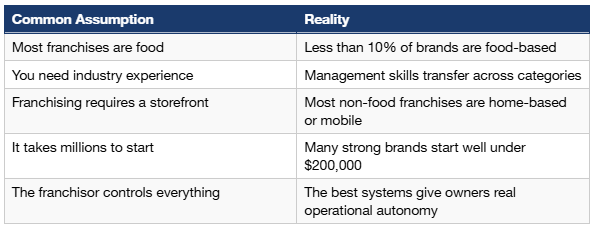
After 27 years in this industry, having operated as a franchisor, franchisee, and area developer, I have seen what happens when candidates make decisions based on assumptions instead of information. The goal of every conversation I have is to replace assumption with facts.
With over 3,000 brands across dozens of categories, the investigation process is built around narrowing the field to what actually fits your background, your market, and your goals. A free 15-minute call is where that process begins, focused entirely on your situation. That is how 3,000 options turn into the right few worth exploring.