When most people picture a franchise, they picture food. A drive-through, a sandwich counter, a pizza box. What they do not picture is a business that delivers compassionate care to an aging population and generates consistent, recurring revenue while doing it. Senior care franchising is one of the most compelling categories in the industry, yet it is consistently among the most overlooked.
The Demographic Reality
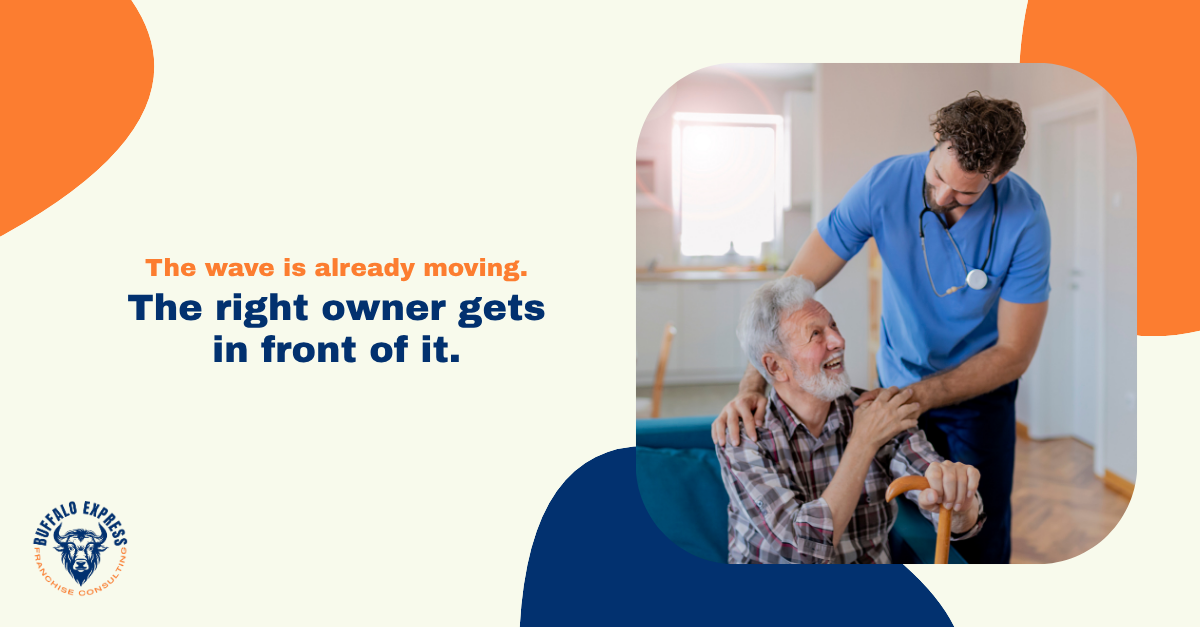
The numbers here are not speculation. They are a slow-moving wave that every analyst can see coming.
By 2030, all baby boomers will be over 65. By 2034, older adults will outnumber children in the United States for the first time in history. The 65-and-older population is projected to reach 80 million by 2040.
That is not a trend. That is a structural shift in the population. And the demand for senior care services will grow with it.
What Senior Care Franchises Actually Do
This category is broader than most candidates realize. Here is a breakdown of the primary types:
Non-medical in-home care: Companions and aides assist seniors with daily tasks, transportation, meal preparation, and personal care. No medical licensing required in most models.
Medical home health: Skilled nursing and therapy services delivered in the home. Requires licensed staff and higher regulatory complexity.
Memory care and adult day services: Structured programs for seniors with Alzheimer’s and dementia, in a facility or community setting.
Senior placement and advisory services: Help families navigate care options and transitions. Low overhead, high relationship-driven revenue.
The non-medical in-home care model is where most franchise candidates start. It has the lowest barrier to entry, the most established franchise systems, and the clearest path to scale.
The Business Case
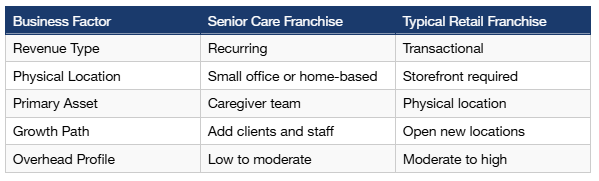
Senior care franchises are built on recurring revenue. A client who needs 20 hours of care per week does not stop needing it after one visit. They need it every week, often for months or years. That is fundamentally different from a transaction-based business.
Overhead is also relatively contained. You are not running a retail space. You are managing a team of caregivers, coordinating schedules, and building client relationships. The model scales well because adding clients means adding caregivers.
Purpose-Driven Ownership
I have worked with hundreds of candidates over 27 years. The ones who burn out fastest chose a brand for the numbers alone. The ones who build something lasting almost always care about what their business does in the world.
Senior care franchises attract owners who want their work to matter. They serve real families navigating difficult moments. That sense of purpose drives owner commitment, staff retention, and community reputation.
How I Match Candidates to Senior Care Brands
Not every senior care franchise is built the same. Some are stronger in training. Some have deeper territory support. Some suit first-time owners better. Others reward candidates who have managed large teams.
My job is to understand the candidate first. What are their goals? What does their schedule need to look like? What is their leadership style? Then I match them to vetted brands that fit.
Senior care is not a secret I keep for long. Once a candidate sees the model clearly, it usually rises quickly on their list.
The candidates who get the most from this process are the ones who take the time to see the model clearly before making any decisions. In a free 15-minute call I walk you through what senior care ownership actually looks like day to day, the numbers, the support structure, and the type of operator who thrives in this space.